_edited.png)


Dry Eyes During Menopause? You’re Not Imagining It

If you’re going through perimenopause or menopause and suddenly notice that your eyes feel dry, gritty, irritated, watery, or even blurry, you may be wondering if the two could possibly be connected. They can be.
Hormonal changes during perimenopause and menopause can affect the delicate tear film that keeps your eyes comfortable and your vision clear. For some women, dry eye symptoms may appear for the first time during this stage of life or become noticeably worse.
And no—you’re not imagining it.
Why Can Menopause Cause Dry Eyes?
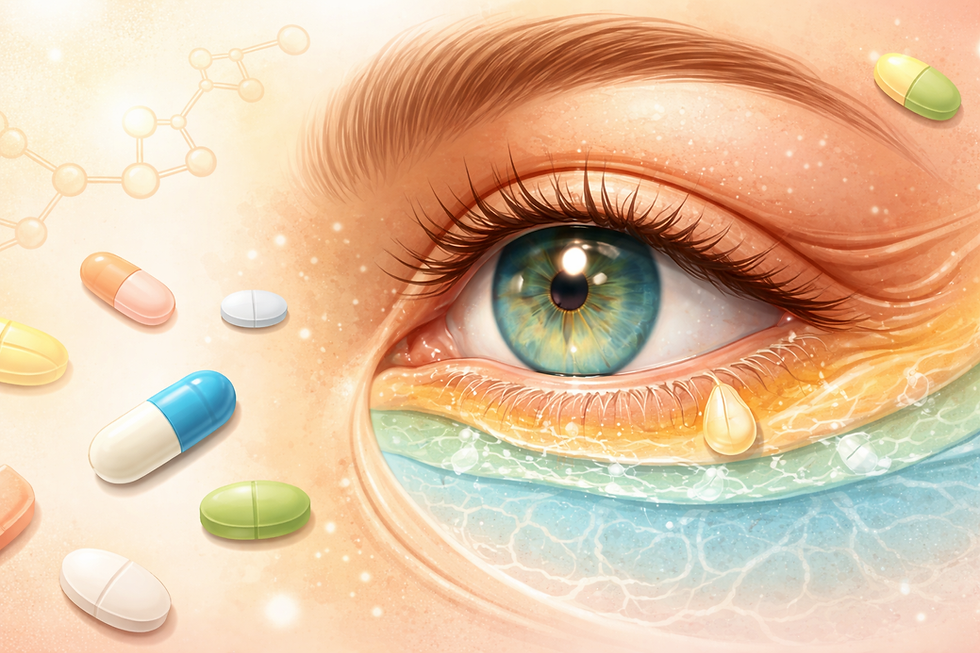
Your eyes depend on a healthy tear film to stay comfortable and maintain clear vision. That tear film contains a carefully balanced combination of water, oils, and mucus.
Hormones influence several parts of this system, including the meibomian glands, which produce the oily layer of your tears. These oils help prevent your tears from evaporating too quickly.
During perimenopause and menopause, changing hormone levels can contribute to changes in the quantity and quality of your tears and the function of the meibomian glands.
The result can be evaporative dry eye, where your tears evaporate faster than they should.
This is one reason some women notice that their eyes feel different during menopause even if they have never experienced significant dry eye symptoms before.
What Does Menopause-Related Dry Eye Feel Like?
Dry eye doesn't always feel like "dryness."
You may experience:
Burning or stinging
A gritty or sandy feeling
Red or irritated eyes
Excessive watering
Sensitivity to light
Fluctuating or blurry vision
Eye fatigue
Difficulty wearing contact lenses
A feeling that something is stuck in your eye
Symptoms that are worse after reading or computer use
One particularly confusing symptom is watery eyes.
It seems counterintuitive, but eyes can actually water excessively when they are dry. When the surface of your eye becomes irritated, your lacrimal glands can produce a sudden burst of watery tears. Unfortunately, these reflex tears don't necessarily contain the right balance of oils and other components needed to keep the eye comfortably hydrated.
So if your eyes are simultaneously dry and watery, you may still have dry eye disease.
Why Do My Eyes Feel Worse During Menopause?
Hormonal changes aren't necessarily the only factor.
Dry eye during midlife can be influenced by several things occurring at the same time.
Meibomian gland dysfunction
The meibomian glands are tiny oil-producing glands located along your eyelids.
Their job is to release oil onto the surface of your tears and slow evaporation.
If these glands become clogged or aren't producing healthy oils, your tears can evaporate too quickly.
This condition is called meibomian gland dysfunction (MGD) and is one of the most common contributors to evaporative dry eye.
Screen time
If you're spending much of your day looking at a computer, phone, or tablet, you may also be blinking less frequently or incompletely.
Less effective blinking means your tear film isn't being evenly redistributed across the eye as often as it should.
Contact lenses
Contact lenses can make dry-eye symptoms more noticeable, particularly when the tear film is already unstable.
Some women who have comfortably worn contacts for years find that their lenses become increasingly uncomfortable during perimenopause or menopause.
Medications
A number of commonly used medications can contribute to dry-eye symptoms, including certain antidepressants, antihistamines, blood-pressure medications, and other medications.
If your symptoms began after starting a new medication, don't stop taking it on your own. Instead, talk with your prescribing physician and your eye doctor about whether it could be contributing to your symptoms.
Environment
Dry air, air conditioning, heating systems, fans, wind, and low indoor humidity can all increase tear evaporation.
Is Menopause-Related Dry Eye Permanent?
Not necessarily.
But if you're experiencing persistent symptoms, it's worth having your eyes evaluated rather than simply assuming that you have to live with them.
Dry eye is not one single condition, and the best treatment depends on what is actually causing your symptoms.
For example, someone whose primary problem is meibomian gland dysfunction may benefit from treatment directed at the oil-producing glands, while another patient may have significant inflammation, inadequate tear production, eyelid problems, medication-related symptoms, or several contributing factors at once.
That's why simply switching from one bottle of artificial tears to another doesn't always solve the problem.
What Can You Do About Dry Eyes During Menopause?
Treatment should be individualized based on the underlying cause and severity of your dry eye.
Depending on your examination, treatment may include:
Artificial tears
Lubricating eye drops can provide temporary relief, particularly for mild or intermittent symptoms.
Preservative-free formulations are often preferred when drops are needed frequently.
Warm compresses and eyelid care
If meibomian gland dysfunction is contributing to your symptoms, consistent eyelid hygiene and appropriate heat therapy can help support healthier gland function.
Prescription treatments
Some patients need more than lubrication. Prescription medications may be used to address ocular-surface inflammation or improve tear production.
In-office dry eye treatments
For patients with significant meibomian gland dysfunction, in-office treatments can target the underlying gland dysfunction rather than simply replacing the tears that are being lost.
Depending on the patient's condition, treatments such as thermal gland therapy, meibomian gland expression, or IPL (intense pulsed light) may be considered.
The important point is that these treatments aren't appropriate for everyone. A thorough dry-eye evaluation helps determine which approach makes sense for you.
When Should You See an Eye Doctor?
Consider scheduling an eye examination if your dry-eye symptoms are:
Persistent or getting worse
Interfering with your work or daily activities
Making contact lenses uncomfortable
Causing fluctuating vision
Associated with significant redness or irritation
Requiring frequent use of artificial tears
Not improving with over-the-counter treatment
It's especially worth getting evaluated if your symptoms appeared or changed significantly during perimenopause or menopause.
Your symptoms may be related to hormonal changes—but there may also be an underlying condition such as meibomian gland dysfunction that can be specifically treated.
The Bottom Line
If your eyes suddenly feel different during perimenopause or menopause, you're not imagining it.
Hormonal changes can affect the tear film and the glands responsible for maintaining a healthy ocular surface. But menopause isn't necessarily the entire explanation.
The good news is that dry eye is treatable, and identifying the underlying cause is an important first step toward finding relief.
If you're experiencing persistent dry, burning, gritty, watery, or fluctuating eyes, a comprehensive dry-eye evaluation can help determine what's actually happening—and what treatment is most likely to help.
Clear and comfortable vision shouldn't have to be something you simply accept losing with age.


Comments